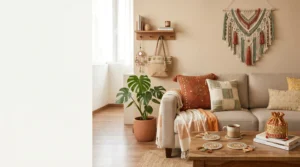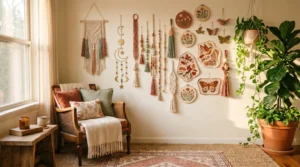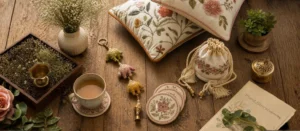
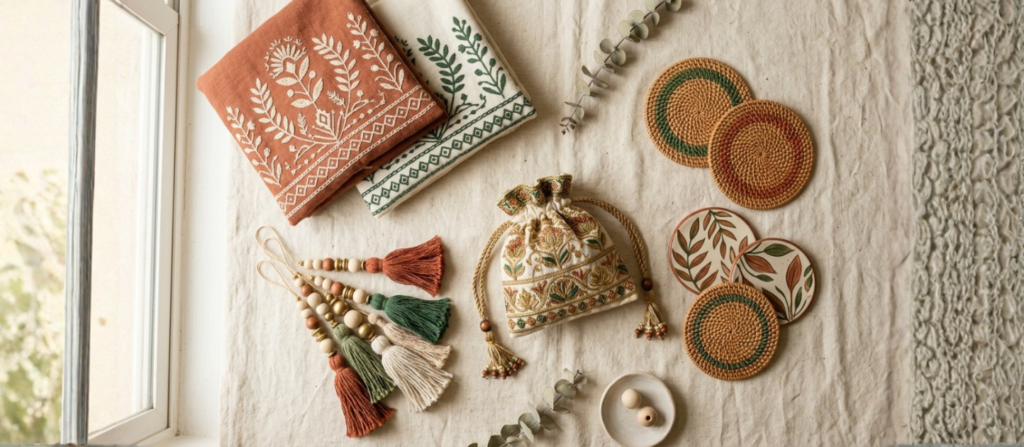
When you’re decorating your home, one of the most meaningful choices you’ll make isn’t about colour or style — it’s about how your pieces were made. Walk into any home décor store today and you’ll find beautifully displayed items, but there’s a world of difference between something crafted by a skilled artisan and something rolled off a factory assembly line.
At Etaliya, we celebrate the art of handcrafted décor — from embroidered cushion covers to intricate hanging decorations. But we also believe in helping you make informed decisions. This guide breaks down everything you need to know.
Table of Contents
- What Are Handmade & Machine-Made Home Décor?
- 7 Key Differences You Should Know
- Side-by-Side Comparison Table
- Why Handmade Décor Is Worth Every Rupee
- When Machine-Made Makes Sense
- How to Spot Genuine Handmade Products
- FAQs
- Conclusion
1. What Are Handmade & Machine-Made Home Décor?
Handmade Home Décor
Handmade home décor refers to products crafted entirely, or largely, by the skilled hands of artisans. Every piece reflects hours of human effort, traditional techniques passed down through generations, and a personal touch that machines simply cannot replicate.
Examples include:
- Hand-embroidered wall art and textile hangings
- Hand-beaded hanging decorations and ornaments
- Handwoven cushion covers and throw pillows
- Artisan-crafted coaster sets and table accessories
- Handmade bags and potli pouches
- Decorative napkin rings with artisan motifs
Machine-Made Home Décor
Machine-made home décor is manufactured using automated industrial processes. Items are produced in large quantities with identical specifications, ensuring uniformity across thousands of units. These products are widely available in mass retail stores and designed for efficiency, consistency, and scalability — but they trade away the uniqueness and cultural depth that defines handmade craftsmanship.
2. 7 Key Differences Between Handmade & Machine-Made Home Décor
1. Quality & Craftsmanship
Handmade pieces are crafted with meticulous attention to detail. An artisan may spend hours — sometimes days — perfecting a single cushion cover or a set of coasters. This time investment creates a depth of quality — in texture, finish, and stitching — that industrial machinery simply cannot achieve. Machine-made items prioritise uniformity, which is consistent but often lacks tactile richness.
2. Uniqueness & Character
No two handmade products are exactly alike. Those tiny variations in stitching, colour, or texture are not imperfections — they are signatures of the human hand. When you display a handmade embroidered wall art piece from Etaliya, you own something that exists nowhere else in the world in exactly that form.
3. Materials & Sustainability
Artisan makers tend to source natural, locally available materials — cotton, wool, jute, brass, and clay. Machine manufacturing often relies on synthetic inputs and energy-intensive industrial processes. Choosing handmade is one of the most tangible sustainability decisions you can make for your home.
4. Price & Long-Term Value
Yes, handmade products generally carry a higher price tag. But value is not the same as price. A machine-made ornament may cost ₹99 and last two seasons. A handmade hanging decoration may cost more but become a treasured family heirloom. The cost-per-joy ratio is entirely different.
5. Cultural & Emotional Connection
Every handmade piece carries cultural heritage. Etaliya’s artisans draw from rich traditions of Indian embroidery, beadwork, and textile arts. Each piece in our embroidered wall art collection is a living connection to those traditions. Machine-made items are culturally neutral and carry no such story.
6. Environmental Impact
Small-scale artisan production has a dramatically lower carbon footprint than factory manufacturing. Local material sourcing, smaller batch sizes, natural fibres, and minimal packaging all contribute to a gentler impact on our planet.
7. Supporting Artisan Communities
When you buy handmade from platforms like Etaliya, you directly support the livelihoods of skilled craftspeople — often women artisans in small communities — whose skills are at risk of disappearing in the age of mass production.
3. Handmade vs Machine-Made: Side-by-Side Comparison
| Feature | Handmade | Machine-Made |
|---|---|---|
| Uniqueness | One-of-a-kind | Identical units |
| Quality Feel | Rich, tactile depth | Consistent but flat |
| Price Range | Medium to premium | Budget to medium |
| Materials | Natural & sustainable | Often synthetic |
| Longevity | Heirloom quality | Seasonal lifespan |
| Cultural Value | High — carries heritage | Minimal |
| Eco Impact | Lower carbon footprint | Higher industrial impact |
| Availability | Limited, curated | Mass market |
| Artisan Support | Direct community impact | Corporate supply chain |
| Gift Suitability | Deeply personal & memorable | Functional, practical |
4. Why Handmade Home Décor Is Worth Every Rupee
Stories in Every Stitch Each handmade piece holds the skill, time, and intention of a real human artisan. When you place a handmade item in your home, you’re not just decorating a space — you’re inviting in a story.
Sustainable & Eco-Friendly Choice Natural materials and small-batch production significantly reduce environmental harm compared to factory manufacturing. If living sustainably matters to you, handmade décor is a natural extension of that value.
The Perfect Personalised Gift A handmade gift is unique, personal, and tells the recipient you chose something made with genuine care. Browse our hanging decorations, potli bags, and coaster sets for elegant, memorable gift ideas for every occasion.
Preserving Cultural Heritage India has one of the world’s richest traditions of textile arts, embroidery, and beadwork. By choosing pieces like Etaliya’s embroidered wall art or napkin rings, you help keep these centuries-old crafts alive and economically viable for future generations.
Instant Conversation Starter Handmade pieces are naturally beautiful and interesting — they invite curiosity and conversation. Guests always notice and ask about them, making your home feel curated and personal rather than catalogue-bought.
5. When Does Machine-Made Home Décor Make Sense?
We strongly champion handmade, but we’re also realistic. There are situations where machine-made is the pragmatic choice:
- When you need large quantities of identical items — such as décor for a corporate office or event
- When you’re working within a very tight budget
- For high-use utility items where aesthetics are secondary to function
- When a specific technical precision or exact colour match is required
- For temporary or seasonal décor you don’t plan to keep long-term
But for your home — a space you live in, feel in, and welcome loved ones into — handmade brings a warmth and soul that no machine can manufacture.
6. How to Spot Genuine Handmade Products
Look for Slight Natural Variations Genuine handmade items will have tiny, beautiful inconsistencies — a bead that’s fractionally different, stitching that’s uniquely spaced. These are marks of authenticity, not defects.
Check Material Descriptions Carefully Real handmade décor names specific, natural materials — 100% cotton, hand-spun wool, brass fittings, natural jute. Vague descriptions like “fabric” or “material” without detail are a red flag.
Look for Artisan Transparency Reputable handmade brands are transparent about who makes their products and how. At Etaliya, our products are made by skilled Indian artisans using traditional craft techniques.
Feel the Weight and Texture Natural materials have a characteristic weight and warmth that’s unmistakable. Our cushion covers and coaster sets use fabrics that feel distinctly different from synthetic, machine-made counterparts.
Buy from Verified Artisan Platforms Platforms dedicated to handmade goods — like Etaliya.com — vet their artisans and products carefully. You’re not just buying décor; you’re buying a verified piece of authentic craft.
7. Frequently Asked Questions
Is handmade home décor more durable than machine-made? Yes, often significantly so. When crafted from quality natural materials like cotton, wool, or brass, handmade pieces can outlast synthetic machine-made equivalents by years. Many become cherished family heirlooms.
Why is handmade home décor more expensive? Handmade items are priced higher because they involve skilled human labour, quality natural materials, and significant time investment. However, their longevity, cultural significance, and emotional value make them excellent long-term investments.
Can I buy handmade home décor online in India? Absolutely. Etaliya offers a curated range of handcrafted home décor — from wall art and cushion covers to bags and festive decorations — delivered across India.
What types of handmade décor does Etaliya offer? Etaliya specialises in embroidered wall art, hanging decorations, cushion covers, coaster sets, napkin rings, and handcrafted bags — all made by skilled Indian artisans.
Is handmade décor a good gift idea? It’s one of the best. A handmade gift is unique, personal, and tells the recipient you chose something made with genuine care. Browse our potli bags and hanging decorations for elegant gift ideas.
8. Conclusion: Choose What Story Your Home Tells
The difference between handmade and machine-made home décor isn’t just about price or quality — it’s about what story you want your home to tell. Machine-made items fill a space. Handmade pieces define it.
When you choose handmade, you’re choosing to surround yourself with intention, cultural heritage, and the unmistakable warmth of human creativity. You’re supporting an artisan in a small community, keeping a craft tradition alive, and bringing something genuinely irreplaceable into your home.
Explore Etaliya’s full range of embroidered wall art, cushion covers, coaster sets, napkin rings, handcrafted bags, and hanging decorations — and let every corner of your home reflect a choice made with care.